Showing posts with label pancetta. Show all posts

Sunday, May 8, 2016

Spinach and Ricotta Tortellini with Asparagus, Leeks and Pancetta

Spinach and Ricotta Tortellini with Asparagus, Leeks and Pancetta


For me, this is all about redemption.

Inspiration Behind the Dish

Last month I published my first attempt at a tortellini dish that I made from scratch. Everything about the dish was satisfactory to me except for the shape of my pasta. I'll be honest and note here that the flaw haunted me, so I needed to exorcise my demon to retain my sanity. In addition, I also used the opportunity to document with more detailed pictures the process of making the tortellini.

Dish Details

I used my tried and true pasta dough recipe which can be found on pages 102 to 104 of Cook Like A Rock Star by Anne Burrell with Suzanne Lenzer. I pulled from a number of sources for the tortellini filling including Two Peas and Their Pod, food.com and Cooking with Manuela. In addition, I relied upon a number of YouTube videos in order to shape each tortellino. I paired my tortellini with a seasonal vegetable side dish from page 174 of Michael Chiarello's Casual Cooking By Michael Chiarello with Janet Fletcher. I would hope that this dish would be at home at any Italian trattoria.

Ingredients

For the filling:
8 ounces chopped spinach, rinsed
10 ounces ricotta cheese, drained overnight
1/4 cup parmesan cheese
1 egg
Kosher salt
Freshly ground black pepper

For the pasta dough:
4 large eggs
1 egg yolk
1/4 cup extra-virgin olive oil
2 tablespoons water, plus more as needed
3 3/4 cups all-purpose flour
1 teaspoon kosher salt

For the vegetable side:
1 1/2 pounds medium asparagus, tough ends broken off, then cut into 1-inch lengths
2 tablespoons extra-virgin olive oil
2 ounces pancetta, cut into 1-inch lengths
1 cup leek, thinly sliced, white and pale green sections only
Kosher salt
Freshly ground black pepper

Method

1. Prepare the filling. Place the wet spinach into a nonstick skillet and season with salt, then place over medium low heat and cover until wilted, approximately 5 minutes. After the wilted spinach has cooled, combine the it with the ricotta, parmesan and egg, then season with salt and pepper. Cover with plastic wrap and set aside while the pasta dough is prepared.


2. Prepare the pasta dough. Whisk together the eggs, egg yolks, olive oil and water in a small bowl, then set aside. On a clean flat surface (I recommend a rimmed baking sheet in the event the well breaks), place the flour and dig a well in the middle so the flour resembles the shape of a volcano. Add the salt to the well, then pour in the wet ingredients. Using a fork, stir the eggs in a circular motion while simultaneously adding flour to the eggs slowly until the eggs are thick enough not to spill over the side of the well. Add the remaining flour to the eggs, and once it has become a homogeneous mixture, knead the dough by rolling it over onto itself with the heels of the palms of your hands, then turning it 90 degrees and repeating the process until it is tacky but not sticky adding more flour or water, as needed. While kneading the dough, ensure its consistent throughout by periodically piercing it with your finger to test the inside. Once the dough is kneaded, wrap it in plastic wrap and let it rest for one hour, however the dish can be prepared one day ahead up to this point.


4. Roll the dough. Open the setting of a pasta roller to its widest. Cut off a portion of the pasta dough and flatten it, ensuring to re-wrap the remaining pasta dough that isn't being rolled. Dust a clean working surface with flour and pass the portion of the dough through the pasta roller, then fold it into thirds and pass the dough through the roller a second time at its widest setting, dusting the dough with flour if it feels too sticky, as needed. Fold it into thirds again, passing the dough through the pasta roller a third time at the widest setting and again, dusting the dough flour if necessary. Adjust the pasta roller to the next thinnest setting (i.e. if the roller is widest at setting 1, switch it to setting 2), and pass through the pasta roller just once at that setting. Continue to pass the dough through the roller once at the next thinnest setting, dusting the dough with flour as required, until your pasta sheets have reached the desired thinness. (My Atlas machine has six settings, but I rolled my dough to setting 5.)


5. Shape the tortellini. Once the pasta sheets have been rolled to the desired thickness, use a ring mold to cut circles into the pasta sheets and retain the excess for another use.


Place 1/2 teaspoon of filling in the center of each, then using your finger, wet with water the edge of one-half of the circle, as demonstrated by the grey shaded area in the picture below.


Fold the circles in half and seal the filling inside, ensuring that no air has been trapped inside the tortellini.


Fold one corner towards the center and, using a finger, wet the tip as demonstrated by the grey shaded area in the picture below. Fold the second corner towards the center to seal the two corners so they stick together.


As you finish each tortellino, place them onto a flour dusted sheet pan and put the sheet pan in the freezer so the pasta doesn't dry out.


6. Prepare the vegetable side; boil the pasta and finish the dish. Bring two pots of salted water to a boil over high heat-one medium and one large. While waiting for the water to reach its temperature, render the pancetta in olive oil in a medium skillet over medium-low heat until slightly crisp, approximately 5 minutes. Add the leek to sweat.


While the leek sweats, add the asparagus to the medium pot and cook until tender, approximately 3 or 4 minutes then drain and add the asparagus to the skillet with the pancetta and leek. Season with salt and pepper to taste and toss to coat the seasonings.


Add the tortellini to the large pot and boil until they float to the top, approximately 2 minutes. Remove the cooked tortellini with a slotted spoon to a paper towel lined plate. To present, spoon a tablespoon or two of the vegetables onto a plate, then top with 4 to 5 tortellini, then serve immediately.

Final Thoughts

Unlike my previous tortellini attempt, I am pleased with the shape of the pasta I made. In addition, my suspicions were correct! By using a ring mold with a larger diameter, I was able to have better control over the final shape of the tortellini. Also, I might suggest to make the tortellini gradually, as each pasta sheet is rolled to the desired thickness before rolling more pasta dough so it doesn't dry out. Lastly, Mrs. Stuntman thought the vegetable side was seasoned perfectly and paired well with the spinach and ricotta filling. She even requested I prepare it again.

Sunday, April 3, 2016

Green and Yellow Artichoke Tortellini with Mushrooms, Pancetta and Spring Peas with White Wine Reduction for an Italian Fest #SundaySupper

Green and Yellow Artichoke Tortellini with Mushrooms, Pancetta and Spring Peas with White Wine Reduction for an Italian Fest #SundaySupper


My long time readers know that one of my passions I've explored on this website is Italian cuisine, so I couldn't let this week's #SundaySupper theme of Italian Fest go without participating. It's hosted by Manu of Manu's Menu. Thank you, Manu!

As this passion has developed over the years, I've tried to learn as much as I can on the topic. What fascinates me is the differences between authentic Italian food and America's version of Italian food which is the reason why I'm so appreciative of an article my friend Caroline of La Cucina Della Prima Donna wrote a few years ago that explains how Italians can still eat healthy despite calorie-laden dishes such as pasta, pizza and gelato.

As I noted in a dish I published this past fall, Italian pasta dishes tend to be simple, so I've struggled to balance genuineness with my desire to continue to prepare foods that challenge me, either in flavor profile and/or preparation. However, I think I found a compromise with an article I discovered several years ago on about.com that reviewed recipes for flavored pastas and have been using it as a source of inspiration ever since. Such is the case with this dish.

Inspiration Behind the Dish

The idea of this dish was born from episode 16 of season six's MasterChef, where the elimination challenge charged the contestants with preparing three fresh pasta dishes. One of the assigned dishes is a squid ink striped farfalle. At the time, I hadn't even considered the concept of striped pasta so I was intrigued and wanted to explore the notion. In addition, my long time readers will remember I prepared a Paglia e Fieno dish two years ago which is the second source of inspiration for this updated version.

Dish Details

When I conceptualized this dish, I imagined it to be served at a modern Italian fine dining restaurant. The dish the contestants on the show I referenced above made pasta with only stripes on one side, so I did a little digging and found a method to ensure the stripes appear on both sides. I also wanted to use seasonal ingredients so, after consulting The Flavor Bible, I decided to use artichokes for my filling in addition to mushrooms, spinach and peas. Think Like a Chef by Tom Colicchio with Catherine Young, Lori Silverbush and Sean Fri played a role in two components of the dish. The reduction was comprised from the basic sauce making technique described on page 75 and the artichoke filling on pages 129 through 130 and 134. Pasta dough was adapted from the about.com article I linked above. I also added the pancetta because The Flavor Bible noted it worked well with artichokes and I've also found I enjoy the pairing of cured pork with mushrooms.

Ingredients

For the artichoke filling:
3 lemons
3 artichokes
1 medium yellow onion, peeled
1 leek, tops trimmed and green outer leaves discarded
1 celery stalk, sliced thin
7 to 8 baby carrots, sliced thin
1/2 cup extra-virgin olive oil
Kosher salt
Freshly ground black pepper
4 sprigs lemon thyme
1 3/4 cups white wine

For pasta dough:
8 ounces raw spinach
6 cups all-purpose flour, divided plus more as needed
Kosher salt
8 eggs, divided

For the vegetables and reduction:
2 tablespoon extra-virgin olive oil, divided
4 ounces pancetta, diced
8 ounces baby bella mushrooms, cut in half lengthwise and then sliced thin
1/2 cup frozen peas, thawed
1 medium shallot, chopped
1 cup dry white wine
2 cups chicken stock
2 tablespoons unsalted butter
Kosher salt
Freshly ground black pepper
Lemon thyme sprigs, for garnish

Method

1. Complete the artichoke mise en place. Combine the juice from 2 1/2 lemons and 2 quarts water in a large bowl. Trim the stem (leaving only 1-inch), then remove the outer leaves and cut off the inner leaves. Next, peel away the outer layers that encircle the heart with a pairing knife, similar to peeling an apple. Scrape out the fuzzy choke and immature leaves using a spoon, then trim the top of the choke, rubbing it with the remaining half lemon frequently to prevent it from oxidizing and turning brown. When finished place the artichoke into the lemon water and repeat the process with the other two artichokes. Cut the yellow onion in half lengthwise, then slice thinly. Repeat the process for the leek.


2. Braise the artichokes. Heat 1/4 cup olive oil in a high sided pot over medium heat until the pot begins to smoke. Add the onions, leek, carrots and celery (i.e. mirepoix) to the pot to sweat, reducing the heat to medium low, seasoning with kosher salt and stirring occasionally, approximately 20 minutes.


Remove the artichokes from the lemon water and add to the pot. Drizzle the chokes with approximately 2 tablespoons olive oil and season with kosher salt, freshly ground black pepper and lemon thyme sprigs. Add the wine to the pot and enough water to cover the artichokes. Bring to a simmer, then reduce the heat, partially cover the pot and let them simmer until the chokes can easily be pierced with a knife, approximately 30 minutes.


Once finished remove from the heat and allow the artichokes to cool in the braising fluid. Purée the artichokes with the mirepoix adding just enough braising fluid so the mixture has the consistency similar to toothpaste. Cover and set aside until the pasta dough has been prepared.


3. Prepare the spinach. Coarsely chop the spinach, then rinse it under cold water. Place the wet spinach leaves in a nonstick sauté pan over medium heat and add a pinch of kosher salt until the spinach wilts, approximately 5 minutes. Remove the spinach from the pan and let it cool. Once the spinach has cooled enough to handle, place them in a double layer of paper towels and squeeze out as much water from them as possible. Purée the spinach in the blender.


4. Make and roll the pasta dough. Make two mounds of flour, each using 3 cups. Dig a hole in each mound to form a well big enough to hold the eggs, then add a pinch of salt to each mound. Whisk 4 eggs together, then pour them into one well. Whisk the remaining 4 eggs together with the puréed spinach and pour it into the second well. Make, knead and roll each dough separately by following the instructions of Steps 4 and 5 in this prior agnolotti dish, however stop rolling the dough one setting thicker than desired. (For example, my Atlas machine has 6 settings but wanted my pasta as thin as setting 5 so I stopped rolling the dough at setting 4.) Many pasta dough recipes direct the cook to use a clean flat surface but I recommend using a sheet pan because the sides will contain the eggs in the event that the well should break. Dust both sides of each pasta dough with flour and then roll each dough up as if you were rolling a cigarette, then cut it lengthwise in half similar to this picture, cutting along the blue rubber band. Unroll each half and wet the edge of the cut side of each green pasta sheet with water, then lay a yellow pasta sheet next to the green so the yellow sheet overlaps the green sheet by a 1/4-inch. Repeat the process with the remaining sheets. Pass the combined dough through the pasta roller at the final setting.


5. Form the tortellini. Using a ring mold, cut circles in the pasta sheets in a manner that half of the circle is green and the other half is yellow. Using the reserved artichoke filling and the pasta cirecles, fold the tortellini in the manner demonstrated in this YouTube video, ensuring that each tortellino is folded in a manner so the half circle has a different color on each side. If you're not preparing the dish immediately, place each tortellino on a sheet pan dusted with flour and place in the freezer.

6. Prepare the sauce and finish the dish. Bring a large pot of well salted water to a boil over high heat. Add the tortellini to the pot and boil until they float to the top, approximately 2 minutes. Remove the tortellini from the pot and set aside to reserve. In a large skillet, heat 1 tablespoon olive oil over medium heat. Once hot, add the pancetta to render the fat, approximately 5 minutes. Add the mushrooms to the pancetta to sweat and reduce, stirring occasionally. Add the peas to the skillet and cook until heated through.


Remove the pancetta, mushrooms and peas from the pan and reserve. If the pan is dry, add the remaining tablespoon to the skillet, then the shallot to sweat for approximately 3 minutes. Deglaze the pan with wine and scrape the bottom to release any fond and reduce by half. Add the chicken stock and continue to simmer until the sauce is thick enough to coat the back of a spoon. Strain out any solids in the sauce and return it to the skillet over low heat and add the butter, stirring until it melts. Adjust the seasoning of the sauce with kosher salt and freshly ground black pepper. To plate, spoon some of the reduction into a bowl, top the reduction with the mushrooms, pancetta and peas, then place tortellini onto the vegetables. Garnish with lemon thyme sprigs.


Final Thoughts

I was discussing this dish with my friend, Kim of Cravings of a Lunatic and Kiss My Smoke before I published it today. I explained that this dish is as far as I can escalate the complexity of fresh pasta. As I stated above, I intended this dish to be an example of food that could be served at a modern Italian fine dining establishment. Overall, I was pleased with the taste of the dish, as it was well balanced with strong flavors, however I was not happy with it's presentation. If you perform a google image search for tortellini fine dining, you'll get a general idea of what I had in mind. I think the issue is the size of the pasta circles I cut. I used a 3-inch ring cutter so when I went to wrap them around my finger, I found that they didn't reach all the way around. so I ended up folding both corners over to seal with water. When I make tortellini again, I'd use my 5-inch ring mold. I hoped to document the process of forming the tortellini in a little more detail with pictures, however I so focused with making the tortellini I forgot about my camera.

I've reviewed the process of making fresh pasta several times in the past and I've hoped to dedicate a post focused solely on this one aspect, however my hands get rather messy with flour and eggs when I knead the dough so it's difficult to take pictures. Probably the best demonstration I've found is this one by Chef Tomm Johnson I found on YouTube. He initially combines the wet and dry ingredients in a mixing bowl instead of using the well method I describe above, however.

Be sure to check out the other great Italian dishes before you go!

Appetizers:
Mains:
Dessert:
Beverages:
And Artichoke Torta plus More Recipes for Italian Fest from Sunday Supper Movement

Sunday Supper MovementJoin the #SundaySupper conversation on twitter on Sunday! We tweet throughout the day and share recipes from all over the world. Our weekly chat starts at 7:00 pm ET. Follow the #SundaySupper hashtag and remember to include it in your tweets to join in the chat. To get more great Sunday Supper Recipes, visit our website or check out our Pinterest board.Would you like to join the Sunday Supper Movement? It’s easy. You can sign up by clicking here: Sunday Supper Movement

Sunday, February 9, 2014

Pan Seared Scallops with Lemon-Basil Beurre Blanc, Pancetta, Apple and Fennel for a #SundaySupper Valentine's Dish for Two

Pan Seared Scallops with Lemon-Basil Beurre Blanc, Pancetta, Apple and Fennel


I hate Valentine's Day. Don't get me wrong; I can appreciate the sentiment but let's look at what the day has become over the years for us guys: First, we get to spend $150 for a dozen roses that can be bought for $20 the other fifty-one weeks of the year on top of a box of chocolates that will come back to bite us in the ass the first week of March when our lady asks do I look fat?. Then we get to go to a local fine dining establishment where you can get up close and personal...with the couple two tables over because you can hear their conversation as you're packed in the building like sardines.

Romantic, eh?

I have a better idea. Unfortunately, you're on your own with the florists and confectioners, but why not take the time to cook at home? This week, the team at #SundaySupper Movement decided to tackle Valentine's Day recipes for two to help out.

The Challenge

In terms of the dish itself, I wanted to achieve redemption with this dish on a couple of levels. First, I was not satisfied with the sear on the scallops dish I published about a year ago. Second, a couple of weeks ago I had problems adding butter to a sauce so I wanted to address the issue head on.

The Source

I relied heavily on The Flavor Bible for the flavor profiles of the dish but got a little help from The Atlantic magazine and some inspiration from Green Spot Blue

Ingredients

1 Granny Smith apple, julienned
1 small fennel bulb, sliced thin
1 1/2 tablespoons extra-virgin olive oil, divided
3 ounces pancetta, diced
6 to 8 sea scallops
Kosher salt and freshly ground black pepper
1 shallot, chopped fine
1 cup white wine
Juice from 1/2 lemon
1 stick unsalted butter, cut into small cubes, but kept refrigerated until used

Method

1. Place the apples and fennel into a bowl of ice water and set aside.

2. Heat 1/2 tablespoon oil in a medium sauté pan. Once hot, add the pancetta and render fat but don't let it crisp, approximately 5 minutes. Remove to a paper towel lined plate and set aside.


3. In a large skillet, heat the remaining tablespoon olive oil over high heat. Pat the scallops dry and season with kosher salt and freshly ground black pepper. Once hot, add the scallops and sear on one side only, approximately 1 to 2 minutes. Remove from pan and set aside to allow for carryover cooking while the sauce is prepared.

4. For the beurre blanc, combine the shallot, wine and lemon juice in a saucepan and bring to a boil over medium-high heat. Reduce the mixture until it's nearly dry (approximately 3 tablespoons). Reduce the heat to low and whisk in 2 to 3 cubes of butter, continually whisking until melted. Once melted, repeat the procedure with additional cubes until all the butter is used. Control the heat of the sauce by whisking off heat if necessary so the sauce does not separate. It should be thick and creamy. Add in the basil to wilt for 1 minute and season with kosher salt and freshly ground black pepper to taste.


5. For presentation, spoon some sauce onto a plate, top with 3 to 4 scallops, then scatter the apples, pancetta and fennel and serve.

Successful?

First, since I didn't mark my two year anniversary of this blog properly, I wanted to note here that this is my 100th post.

For the scallops I went over to Whole Foods but found fresh ones to be very pricey. The frozen ones were a little better but in talking to their employee who works behind the seafood counter, the reason I had so much trouble with them last time is because of the nitrates used to preserve frozen scallops that are sold in many supermarkets. The ones I bought didn't contain any that weren't naturally occurring and I was happier with the sear I achieved.

One other revelation I had was when I dined at Arcadia about a month ago. (If you'll remember, I ate scallops that evening too.) Before I ate, I turned the scallops over and noticed that they were only seared on one side but were still cooked through, so I attempted the technique here and was successful.

The sauce also didn't break this time. In fact, it was the highlight of the dish.

If I prepare this dish again, I might treat the apples and fennel with a vinaigrette.

Overall, I'm very proud of this dish. It was the most well balanced plate of food I've conceptualized in both flavor and texture. In addition, I'm also pleased with it's presentation, as I consider it the prettiest I've constructed to date.

Happy Valentine's Day!

Other Sunday Supper Participants

And finally, please check out this week's other Sunday Supper contributors:

Alluring Appetizers:

Exquisite Entrees:


Decadent Desserts and Drinks:

Join the #SundaySupper conversation on twitter every Sunday! We tweet throughout the day and share recipes from all over the world. Our weekly chat starts at 7:00 pm ET. Follow the #SundaySupper hashtag and remember to include it in your tweets to join in the chat.

Check out our #SundaySupper Pinterest board for more fabulous recipes and food photos.

Would you like to join the Sunday Supper Movement? It’s easy! You can sign up by clicking here: Sunday Supper Movement.

Would you like to join the Sunday Supper Movement? It’s easy. You can sign up by clicking here: Sunday Supper Movement.

Tuesday, November 26, 2013

Spaghetti Ubriachi for a Thanksgiving #WeekdaySupper

Spaghetti Ubriachi


Earlier this year, the team at Sunday Supper Movement expanded their reach by introducing #WeekdaySupper. The concept is very similar to my Light Stunt series: quick and easy meals that can be prepared after returning home from a long day at the office. A different member of the Movement publishes a dish each weekday, Monday through Friday.

The Challenge

There are several motivations for this dish. First, I wanted to update a similar dish I profiled in the summer of 2012 with an easier method. Second, these ingredients are staples and it wouldn't be a stretch to already have them on hand especially this week. Third, this is a good way to use leftover wine and finally, I recently accepted the position of moderator within the Sunday Supper team, but hadn't participated in a Weekday event and needed to so I could advise other members, should the need arise.

The Source

Adapted from page 80 of Fabio's Italian Kitchen by Fabio Viviani with Melanie Rehak.

Ingredients

2 quarts water
1 750-mililiter bottle red wine
1 teaspoon sugar
Kosher salt, as needed
1 pound dried spaghetti (Do not use fresh pasta)
1/2 pound pancetta, diced (I substituted bacon)
2 tablespoons unsalted butter
1/2 cup ricotta cheese
1/2 cup shelled walnuts, chopped
Freshly grated parmesan, for garnish
Fresh Italian parsley, chopped for garnish

Method

1. Combine the water, sugar, salt and wine in a large stockpot and bring to a boil over high heat. Drop the pasta and cook until just shy of al dente (normally about 2 to 3 minutes less than the package instructions). Reserve 1/2 cup of the cooking liquid then drain in a colander and set aside.


2. In a large skillet, melt the butter over medium heat, then add the pancetta to render it's fat. Add the reserved spaghetti with the reserved boiling fluid, 1 tablespoon at a time until the fluid has been absorbed and the pasta is al dente. Remove from heat, then toss with the ricotta and walnuts. Serve in warmed bowls garnished with parmesan and parsley.


Successful?

I probably should point out that spaghetti ubriachi is Italian for drunken spaghetti. Yes, this dish was well balanced in flavor, but then again, it's difficult to screw up wine, cheese, pasta and bacon.

Oh, and please don't forget to check out this week's other WeekdaySupper participants:

Sunday Supper Movement


Monday, September 10, 2012

Guest Post at La Cucina Prima Donna: Chicken Marsala

Chicken Marsala


My second dish this month is another guest post. This time, I have prepared a dish for Carolina of La Cucina Prima Donna. Carolina is an Italian opera singer residing in New York and was even featured in a New York Daily News article. Carolina wrires about Italian dishes, restaurant reviews, and finding Italian ingredients and stories of her trips to Italy. Please 'Like' her facebook page.

When I volunteered to write a guest post for Carolina, her only requirement was to profile an Italian dish. I reviewed the dishes she'd prepared already and noticed she had not profiled a staple that has made it onto countless Italian casual dining chains here in the United States. Regular readers will be familiar with my disdain for these types of restaurants, so I couldn't pass up the opportunity to improve upon it at home.

If you want the recipe, then head over to La Cucina Prima Donna now. Then come back for an altered method.

Here, I'll wait....

So after I prepared this dish, I was discussing it with a friend of mine, Chef Robert Dasalla of Little Chef Counter, because I wanted to consolidate the preparation to just a single pan. First, I wanted to make clean-up easier but more importantly, I was concerned the flavors wouldn't blend with each other properly if the mushrooms were sautéed in a separate pan, not to mention the loss of any fond. He recommends rendering the pancetta after removing the seared chicken in the same pan, then sautéing the shallots and mushrooms with the pancetta after it has rendered. Deglaze with the marsala then add in the stock and bring to a simmer. Add back the chicken, cover and reduce heat to low for 30 minutes. Remove the chicken from the pan and then stir in some butter and mascarpone and simmer to thicken the sauce. Spoon sauce over chicken and serve immediately.

On a personal note, this may or may not be my last dish I profile this month because I am in the process of moving to a different apartment (i.e. cheaper rent) so, in the meantime, I'll leave you with a preview of where I'll be preparing future stunts. Hopefully my kitchen will remain this clean...


Monday, February 13, 2012

Bucatini all'Amatriciana

Bucatini all'Amatriciana


Over this past weekend, the third season of Worst Cooks in America premiered. In order to build a following, Food Network ran repeats of season two on Saturday afternoon. In one of the episodes, the contestants were challenged with repeating several skills they had learned earlier in the season in one decathlon (e.g. julienning carrots or filleting fish). They were timed, but accuracy was just as important. In watching the contest, it occurred to me that, while I consider myself a knowledgeable cook, I'm a little slow in the completion of tasks.

The Challenge

What this challenge boils down to is preparing a quality mise en place quickly. I can't rush the process of cooking the dish and Chef Chiarello went to a lot of trouble adjusting the dish appropriate for a weeknight. First, the recipe as it appears in the book followed by the time elapsed to complete each task.

The Source

Page 110 of Michael Chiarello's Casual Cooking by Michael Chiarello with Janet Fletcher

Ingredients

1/3 pound pancetta in one piece, partially frozen (freeze for about 30 minutes to make it easier to slice)
2 tablespoons extra-virgin olive oil
1 onion, thinly sliced, onion-soup style*
3/4 pound spaghetti or bucatini
Scant 1/4 teaspoon red pepper flakes
1 tablespoon fresh Italian (flat-leaf) parsley, chopped
1 1/2 tablespoon red wine vinegar
3/4 cup tomato pureé
Freshly grated Pecorino

Method

1. Bring a large pot of salted water to a boil over high heat.

2. Meanwhile, unroll the pancetta. Cut into 1-inch-long chunks, then slice each chunk thinly across the grain.

3. Heat the olive oil in a large skillet over moderately low heat. Add the pancetta and cook until it renders some of its fat, about 5 minutes. Do not allow it to crisp. Add the onion and cook until soft, about 10 minutes. While the onion is cooking, add the pasta to the boiling water.

Onions Added

4. Add the red pepper flakes and parsley to the onion mixture and cook briefly to release their fragrance. Add the wine vinegar and simmer briskly until it evaporates, then add the tomato pureé and 1/4 cup of the pasta water. Simmer briefly to blend.

5. When the pasta is just shy of al dente, drain it and return it to the warm pot over medium heat. Add the sauce and cook briefly so the pasta absorbs some of the sauce, then transfer to a warmed serving bowl and shower with the pecorino. Serve immediately.

*Onion-soup style: Slice off both ends, then halve lengthwise and peel. Now slice thinly lengthwise (from stem end to root end), not crosswise. This method gives you shorter, more even slices instead of long, stringy slivers that can be unpleasant to eat, especially in a soup.

Successful?

With the task of completing my prep work in a timely manner, the mise en place was finished in 44 minutes (which includes freezing the pancetta). Start to finish, it was about a ninety minute project, so I was successful from that standpoint. If I were to repeat this dish again, I'd use medium heat to render the pancetta and use more tomato pureé. Overall a good weeknight meal and, for two people, enough leftovers to brown bag it the next day.

Thursday, February 2, 2012

Spaghetti alla Carbonara

Spaghetti alla Carbonara


The Challenge

Uncommon cooking method. Can the heat from the pasta cook the eggs adequately?

The Source

Page 111 of Cook Like A Rock Star by Anne Burrell with Suzanne Lenzer

Mise En Place

Kosher salt
Extra-virgin olive oil
3/4 cup pancetta, cut into 1/4-inch dice
1 pound spaghetti
8 large eggs
1/2 cup freshly grated Parmigiano
1/2 cup freshly grated Pecorino
Freshly ground black pepper
4 scallions, green parts only, cut into 1-inch lengths on a severe bias

Method

1. Bring a large pot of well-salted water to a boil. Coat a large skillet with olive oil and bring it to medium heat. Add the pancetta and cook, stirring occasionally, until it starts to color and become crisp, 6 to 8 minutes; remove from the heat.

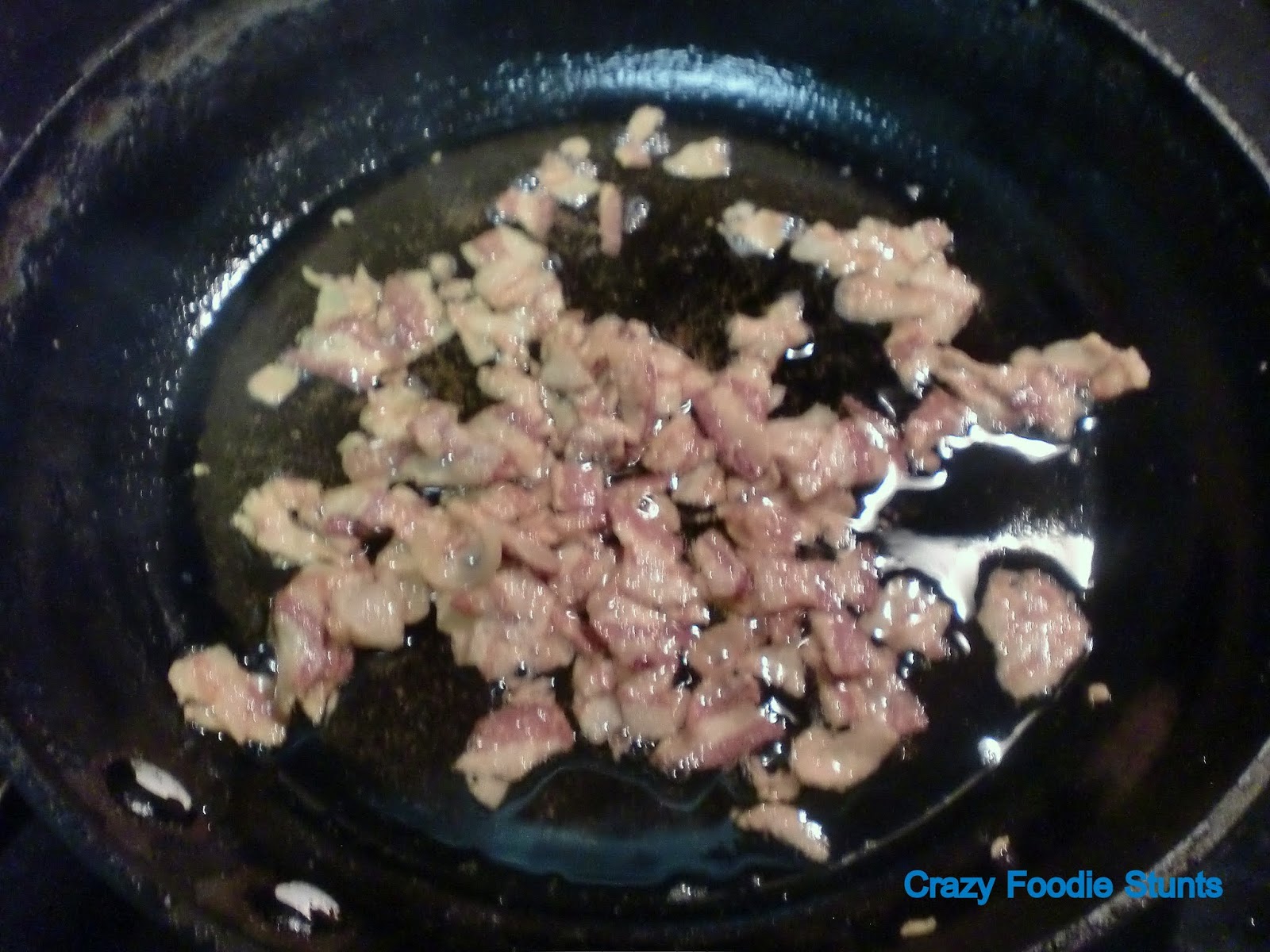
Rendered Pancetta

2. Add the pasta to the boiling water and cook for 1 minute less than the instructions on the package suggest. Taste it: It should be tooth-some with just a little nugget of hard pasta still in the center-this is al dente.

3. While the pasta is cooking, crack the eggs into a large bowl and add the grated Parm and Pecorino; season with salt and whisk vigorously until well combined. Season with black pepper.

Egg and Cheese Mixture

4. Bring the pan with the pancetta back to medium heat. Drain the pasta, add it to the pan, and coat it with any fat in the skillet. Remove the pan from the heat, add the egg mixture to the pasta, and stir vigorously to combine. Cover and let it sit for 1 to 2 minutes so the steam gently cooks the eggs. Uncover and stir again-the egg mixture will seem like a cream sauce. Serve immediately garnished with sliced scallions.

Pasta Coated With Fat

Successful?

Yes, the eggs cooked adequately from the steam.